🌕 中秋节 Zhōngqiū Jié – When the Moon Brings Families Together
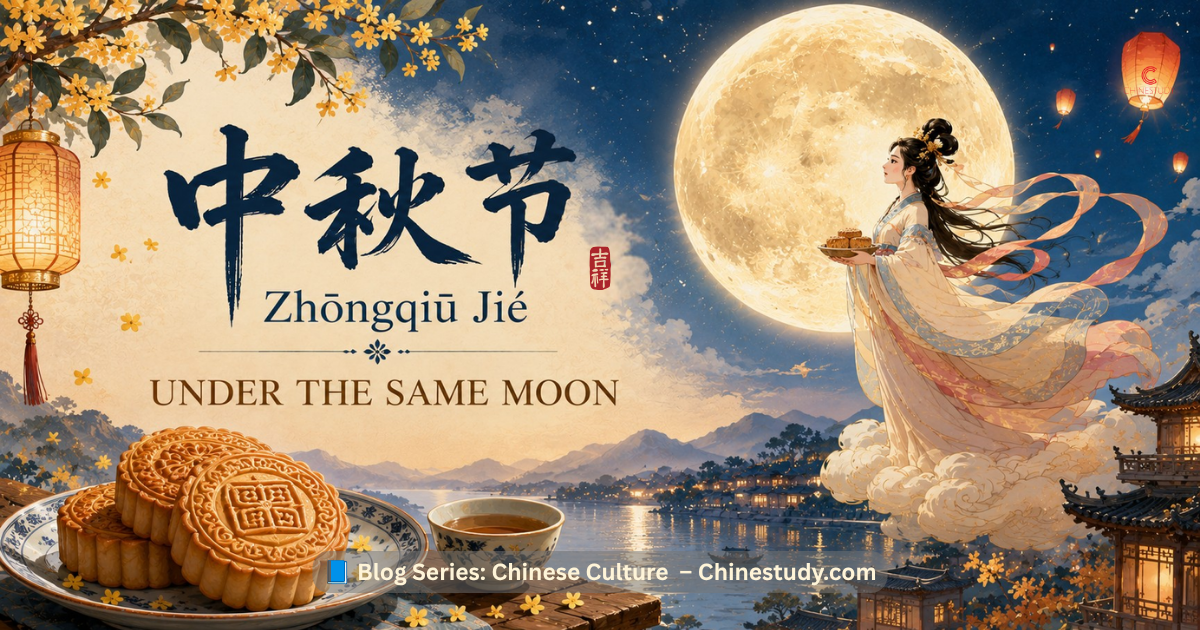
One night in autumn, families look up at the same full moon.
There are mooncakes on the table, lanterns glowing outside, and people thinking of family members who may be far away.
This is 中秋节 (Zhōngqiū Jié), the Mid-Autumn Festival.
🌕 What Is 中秋节?
中秋节 (Zhōngqiū Jié), or the Mid-Autumn Festival, is one of the most important traditional festivals in China.
It falls on the 15th day of the eighth month of the Chinese lunar calendar, when the moon is traditionally celebrated as being at its fullest and brightest.
The festival is also connected with the autumn harvest, but for Chinese families today, its strongest meaning is 团圆 (tuányuán), reunion.
Families gather for dinner, share mooncakes, and enjoy the moon together.
🌝 What Does 中秋节 Mean?
The name 中秋节 (Zhōngqiū Jié) tells us when the festival takes place:
- 中 (zhōng) – middle
- 秋 (qiū) – autumn
- 节 (jié) – festival
So 中秋节 literally means “Mid-Autumn Festival.”
In the traditional Chinese lunar calendar, autumn covers the seventh, eighth, and ninth lunar months.
The festival falls in the middle month of autumn, the eighth lunar month, which is how 中秋 got its name.
📜 Story Behind It
One of the best-known stories of 中秋节 is 嫦娥奔月 (Cháng’é bēn yuè), Chang’e Flies to the Moon.
Long ago, there were said to be ten suns in the sky.
The great archer 后羿 (Hòu Yì) shot down nine of them and saved the people from the terrible heat. As a reward, he received an elixir that could make a person immortal.
Hou Yi gave the elixir to his wife, 嫦娥 (Cháng’é), for safekeeping.
One day, a man tried to steal it. To stop him from taking it, Chang’e drank the elixir herself.
She became very light and flew up to the moon.
Hou Yi was heartbroken. He looked up at the moon and placed out foods that Chang’e loved, hoping to feel close to her.
Over time, the story became closely connected with 中秋节, a festival about reunion, separation, and missing the people we love. 🌕
🥮 How People Celebrate It
Today, 中秋节 is mainly a time for family, food, and the moon.
Families often get together for dinner and spend the evening talking, eating mooncakes, and enjoying the full moon.
This tradition is called 赏月 (shǎng yuè), admiring the moon.
月饼 (yuèbǐng), or mooncakes, are one of the best-known foods of the festival.
Their round shape also echoes the full moon and the idea of 团圆 (tuányuán), reunion and togetherness.
People also give mooncakes to relatives, friends, and colleagues as gifts.
In some places, families and children enjoy colorful lanterns and lantern displays.
Although customs vary across China, the main feeling of the festival stays the same: coming together and sharing the same moon.
🗣 Key Vocabulary & Expressions
- 中秋节 (Zhōngqiū Jié) – Mid-Autumn Festival
- 月饼 (yuèbǐng) – mooncake
- 赏月 (shǎng yuè) – admire the moon
- 团圆 (tuányuán) – reunion; being together as a family
- 月亮 (yuèliang) – moon
- 嫦娥 (Cháng’é) – Chang’e
- 后羿 (Hòu Yì) – Hou Yi
- 中秋节快乐!(Zhōngqiū Jié kuàilè!) – Happy Mid-Autumn Festival!
🧩 Interactive Practice
Translate this sentence into English:
- 中秋节的时候,我们一家人会一起吃月饼、赏月。
- Zhōngqiū Jié de shíhou, wǒmen yì jiā rén yìqǐ chī yuèbǐng, shǎng yuè.
Answer:
During the Mid-Autumn Festival, our family eats mooncakes and admires the moon together.
🇨🇳 Cultural Insight: 圆, 团圆, and the Moon
In Chinese culture, the full moon is closely connected with 圆 (yuán), round, complete, or whole..
A round moon suggests something complete and whole. This is why the Mid-Autumn Festival is strongly associated with 团圆 (tuányuán), family reunion.
Mooncakes are also round, which strengthens the same symbol.
The moon can also connect people who are far apart. Even when family members cannot be together, they can still look at the same moon.
This idea appears often in Chinese poetry. One famous line by 苏轼 (Sū Shì) says:
但愿人长久,千里共婵娟。
Dàn yuàn rén cháng jiǔ, qiān lǐ gòng chán juān.
It expresses a simple wish:
Even when people are separated by a great distance,
they can still share the beauty of the same moon.
This is one reason the moon in Chinese culture can represent both reunion and longing.
🌟 Final Thoughts
中秋节 is more than a festival of mooncakes and lanterns.
It is a time to be with family, to remember people who are far away, and to look up at the same moon.
So this Mid-Autumn Festival, enjoy a mooncake, step outside, and look at the moon. 🌕
Someone you miss may be looking at it too.
🇨🇳 Curious about more Chinese traditions?
📚 Step into the blog series: Chinese Culture!
Thank you for subscribing!
Have a great day!